Hong Kong retail intelligence · international edition
Japanese Brands Do Not Always Mean Japanese Ownership: Who Controls Hong Kong’s Japanese-Style Retailers?
APITA, UNY, SOGO, YATA and Citistore are often grouped together as “Japanese-style retail” in Hong Kong. Yet Japanese merchandise, Japanese service and Japanese ownership are three different things. For overseas visitors, international brands and prospective suppliers, understanding a retailer’s brand origin, current operating company and actual control structure makes Hong Kong’s retail landscape much easier to read.
Three concepts that should not be confused
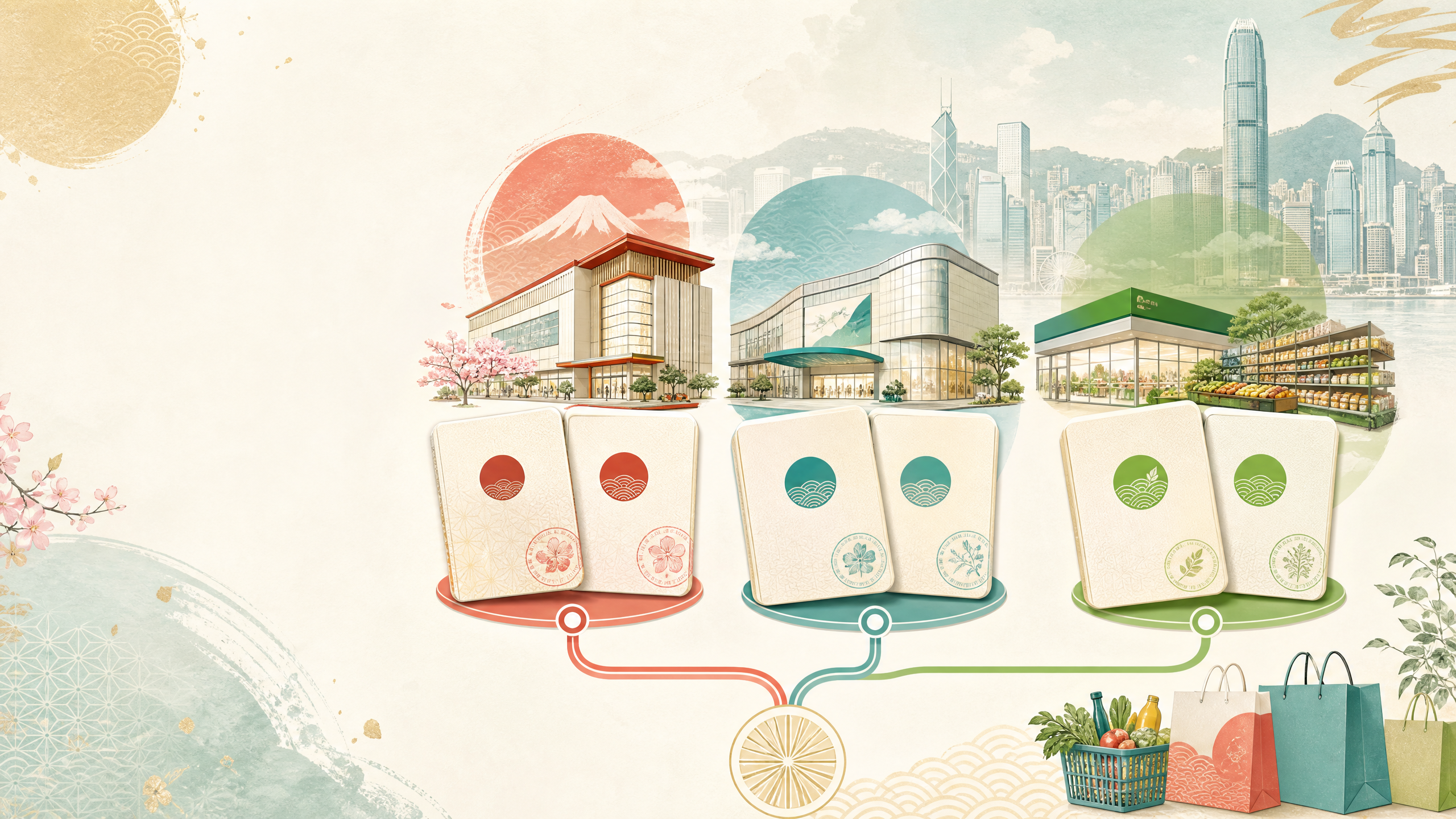
Brand origin
Did the name begin in Japan, or was the business once operated in Hong Kong by a Japanese company? This shapes customer memory, assortment expectations and the meaning of the brand name.
Current control
Is the Hong Kong operating company still part of a Japanese corporate group, or has it been acquired and controlled by a local group?
Operating proposition
Does the store still use Japanese goods, service conventions, lifestyle merchandising or Japanese supply-chain cues as part of its market position?
“Japanese-style” can be a merchandising and service proposition. It is not, by itself, proof that a Hong Kong retailer is still Japanese-owned or Japanese-controlled.
The short answer: which retailers remain Japanese group-controlled?
Among the representative retailers compared here, AEON and Don Don Donki are clear examples of Japanese group-controlled operations. AEON lists AEON Stores (Hong Kong) among its international group companies, while the Hong Kong operating company of Don Don Donki is listed within Japan’s Pan Pacific International Holdings (PPIH) group.[1] [2] It is therefore incomplete to describe AEON as Hong Kong’s only Japanese-controlled retailer.
By contrast, APITA/UNY, YATA and SOGO retain a strong Japanese retail image, while their Hong Kong ownership or operating structures have become localised. Citistore should be understood as a Hong Kong local retail brand rather than a Japanese-origin brand.[3] [4] [5]
Six brands: origin, current control and retail positioning
| Brand / Hong Kong operator | Brand origin and Japanese connection | Current Hong Kong control or operating background | Assessment | What this means for international readers and brands |
|---|---|---|---|---|
| AEON AEON Stores (Hong Kong) |
AEON is a Japanese retail group. Its Hong Kong company is listed by the group as an international business company.[1] | Included in the AEON Co., Ltd. group structure. | Japanese group-controlled | A Japanese-group Hong Kong GMS / supermarket channel. Local buying, listing and commercial requirements should still be confirmed with the Hong Kong operating team. |
| Don Don Donki Pan Pacific Retail Management (Hong Kong) |
Don Don Donki is a Japanese Don Quijote retail concept. | The Hong Kong operating company is listed within Japan’s PPIH group.[2] | Japanese group-controlled | Its discount and discovery-led format does not change its Japanese group connection. Japanese trends, novelty and experiential merchandising remain central to its proposition. |
| APITA / UNY Unicorn Stores (HK) |
The Hong Kong business was formerly UNY (HK) and continues to use APITA and UNY’s Japanese-style retail and service positioning. | Official information states that UNY Hong Kong was acquired by Henderson Investment in 2018 and renamed Unicorn Stores (HK).[3] | Japanese brand origin; locally operated | Do not assume that the Japanese look and feel means Hong Kong decisions are made by a Japanese head office. Identify the Hong Kong operator and buying contact first. |
| YATA YATA Limited |
Its predecessor Seiyu Department Store was established by a Japanese Seiyu company; YATA retains Japanese lifestyle department-store elements in its brand and market position.[4] [5] | Sun Hung Kai Properties acquired Seiyu in 2005 and renamed it YATA in 2008. SHKP identifies YATA as a principal subsidiary.[4] [5] | Former Japanese background; locally controlled | YATA was not a local brand from day one. Today it should be approached as an SHKP-owned Japanese-style retailer with its own local buying process. |
| SOGO Hong Kong Lifestyle International |
SOGO is a Japanese-origin department-store brand. Its Hong Kong store opened in 1985 and continues to trade on a Japanese department-store image for local shoppers and visitors.[6] | It is operated by Lifestyle International, which describes itself as a Hong Kong retailer. Reporting indicates that the Hong Kong assets were acquired by local investors after the Japanese parent company’s 2000 bankruptcy.[7] [8] | Japanese brand origin; locally operated | Brand history and a Japanese retail image remain relevant, but should not be treated as evidence that buying or commercial decisions are led from Japan. |
| Citistore Citistore Department Store |
A local Hong Kong department-store retail brand; it should not be classified as Japanese-origin. | Henderson Investment lists Citistore, APITA and UNY among its Hong Kong retail operations. The three brands also share the CU APP loyalty programme.[3] [9] | Local Hong Kong retailer | It may be viewed as part of the Henderson retail network, but it should not be presented as a Japanese-owned or Japanese-origin brand. |
Key turning points: the name remained, but control changed
Why this matters for overseas visitors and international FMCG brands
First, a Japanese-looking signboard should not be the only clue used to assess a retail channel. Brand origin helps explain customer expectations and merchandising language. The current operator helps identify whom to contact and how to understand a retailer’s current listing process and commercial documentation. Both need to be checked; neither replaces the other.
Second, a Japanese retail feel still has commercial value. Even where control has become localised, Japanese foods, lifestyle goods, service cues, seasonal campaigns and customer expectations may remain important to the store proposition. “Not Japanese-owned” does not mean that demand for Japanese-style products has disappeared.
Third, shared corporate links should not be over-read as shared buying. Citistore, APITA and UNY are listed under Henderson Investment’s Hong Kong retail business, but their formats, categories and commercial arrangements may differ. Any listing plan should be verified through the target retailer’s current buying contact, product documentation and compliance requirements.
Further reading
Simplified Chinese · Mainland & Greater Bay Area editionJapanese Brands Do Not Always Mean Japanese Ownership: Hong Kong Retail Ownership Explained
Channel mapHong Kong Japanese-Style and Local Department Store Retail Channels
Product listingYATA Listing Guide: Costs, Process and Application Tips
Product listingAEON Listing Guide: Costs, Process and Application Tips
Frequently asked questions
Are APITA and UNY still Japanese-owned businesses in Hong Kong?
For their Hong Kong operations, the former UNY (HK) was acquired by Henderson Investment in 2018 and is now called Unicorn Stores (HK). APITA and UNY therefore retain Japanese brand origins and a Japanese-style retail proposition, while the Hong Kong operation is locally controlled.[3] [9]
Was YATA a local company from the beginning?
No. Its predecessor Seiyu Department Store was established by a Japanese Seiyu company. Sun Hung Kai Properties acquired it in 2005, and it was renamed YATA in 2008. Today, YATA is a principal subsidiary of SHKP, but its predecessor had a Japanese background.[4] [5]
Is AEON Hong Kong’s only Japanese-controlled retailer?
That is too broad a conclusion. AEON is a Japanese group-controlled Hong Kong retailer, and Don Don Donki’s Hong Kong operating company is also part of Japan’s PPIH group. Several traditional Japanese-style department-store brands discussed here, however, have moved to local ownership or local operations.[1] [2]
If a retailer is no longer Japanese-owned, does that mean Japanese products are not suitable for it?
No. Ownership and merchandising position are different layers. Japanese food, lifestyle products, service expectations and customer associations can still contribute to the retailer’s value proposition. Suppliers should plan around both the brand position and the actual operating entity.
Sources and how to use this guide
This page prioritises official company, group and Hong Kong operator information. Historical acquisition events are cross-checked with established business and news reporting. Retailers can restructure, sell assets or change operating arrangements; readers considering commercial engagement should confirm current details through the brand’s official website or designated buying contact.
- AEON Co., Ltd.: Major Group Companies.
- Pan Pacific International Holdings: Pan Pacific Retail Management (Hong Kong).
- APITA UNY: Company Information.
- Hong Kong Economic Times: YATA’s former identity.
- Sun Hung Kai Properties: YATA Limited.
- Hong Kong Tourism Board: SOGO Hong Kong Company Limited.
- Lifestyle International: About Us.
- Asia Times: City’s shoppers say sayonara to Japanese department stores.
- Henderson Investment: About the Group.